Sell-offs continue: Dutch rental market keeps shrinking
House seekers in the Netherlands compete for scarce homes and income requirements keep rising
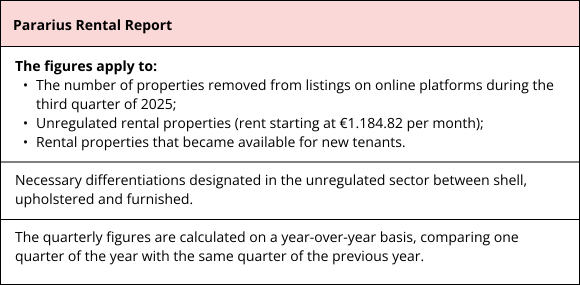
Pararius Rental Report Q3 2025
The Dutch unregulated housing sector remained extremely tight in the third quarter of 2025, according to an analysis by housing platforms Pararius and Huurwoningen.nl. A rental property in the unregulated sector received an average of 42 responses and was listed online for just 18 days; five days fewer than a year earlier. The average monthly rent rose to €1,856, requiring tenants to earn a gross monthly income of at least €5,569 to qualify. The greatest pressure remains in the lower price segment, up to €1,500 per month, but demand in the mid- and high-end segments is also intensifying. Meanwhile, an increasing number of rental properties are being sold rather than re-let, further reducing the already limited supply of homes in the unregulated rental sector.
Number of available rental properties in the unregulated sector
The supply of rental homes in the unregulated housing sector continues to decline. In the third quarter of 2025, more homes were rented out than were newly listed, causing the total number of available rental properties to shrink once again.
In total, 13,985 homes in the unregulated housing sector became available to new tenants in the third quarter of 2025, while 14,715 homes were rented out.
Jasper de Groot, CEO of Pararius: “The overall supply of rental homes continues to shrink: everything that becomes available is rented out almost immediately. As a result, the unregulated housing sector remains completely locked.”
A rental home in the Dutch unregulated housing sector was listed online for an average of 18 days in the third quarter of 2025. This is five days fewer than in the same quarter a year earlier (23 days) and, as in the previous quarter, matches the lowest level since records began. The short listing period highlights the continued tightness of the Dutch rental market, with homes in the unregulated housing sector disappearing almost immediately after being placed online.
Average number of responses per listing
In the third quarter of 2025, a rental home in the Netherlands within the unregulated housing sector received an average of 42 responses. This is slightly higher than a year earlier (41 responses), but below the peak reached in the second quarter of 2025, when an average of 57 responses per home was recorded. The number of responses per property remains historically high, once again showing that competition in the rental market is still intense. Prospective tenants must continue to act quickly to have any real chance of securing an available rental home.
Competition among house seekers in the Netherlands is particularly evident in the lowest segment of the unregulated housing sector, with rents between €1,185 and €1,500 per month. In the third quarter of 2025, 34.3 percent of all responses were posted in this segment, while it accounted for only 26 percent of total supply. For many tenants, this price range remains the only realistic option within their financial means, resulting in intense competition.
Tension is also becoming more apparent in the mid-range segment (€1,500 to €2,000 per month). This category accounted for 40.5 percent of all responses in the third quarter of 2025, compared with 32.7 percent of available rental homes in the Netherlands. As a result, this price level is increasingly becoming the new centre of the rental market, where house seekers are forced to focus as more affordable options continue to disappear.
In the highest segment, with rents above €2,000 per month, the picture is reversed. Here, supply represented 41.3 percent of the market, compared with only 25.2 percent of the responses. This illustrates the imbalance between supply and demand: people in the Netherlands are competing for the relatively more affordable homes, while the more expensive rental properties, although more widely available, remain out of reach for a large group of tenants due to their high cost.
Pressure on the Dutch rental market
To provide insight into the state of the Dutch rental market, property portal Pararius uses the Pararius Tightness Indicator. This indicator combines four elements: total housing supply, the number of newly listed properties, the average listing duration, and the average number of responses per home. In the third quarter of 2025, the Tightness Indicator stood at 0.41, considerably lower than a year earlier, when it measured 0.74. The indicator remains well below the threshold value of 5, which points to a structural landlord’s market. This means that demand for homes in the unregulated housing sector continues to far exceed supply, and properties across the Netherlands are rented out rapidly.
Average rent vs. required gross income
In the third quarter of 2025, new tenants in the Netherlands paid an average of €1,856 per month for a rental home in the unregulated housing sector. According to the standard income guideline, anyone wishing to rent such a property must earn at least three times the monthly rent, which corresponds to a gross monthly income of more than €5,569. This is nearly €330 higher than a year earlier. According to Jasper de Groot, CEO of Pararius, the financial pressure on new tenants continues to grow. For middle-income households in the Netherlands, access to the unregulated housing sector has become almost impossible. At the same time, many earn too much to qualify for a home in the regulated housing sector, leaving them dependent on a market that continues to shrink structurally.
Pararius Rental Price Index (PHI)
Since the first quarter of 2025, rents in the Dutch unregulated housing sector have been rising faster than inflation, measured against the base year 2021. This trend continued in the third quarter of 2025. Compared with the first quarter of 2021, purchase prices have increased by 41.7 percent, inflation by 25.4 percent, and rents by 29.9 percent.
For a long time, rental prices lagged behind general price increases in everyday life, but growth in the unregulated housing sector now exceeds these broader price developments. This means that renting is becoming relatively more expensive compared with other fixed household costs, such as groceries or energy.
This pattern is also evident on a year-on-year basis. Compared with the same quarter a year earlier (Q3 2024), purchase prices rose by 7.7 percent, followed by rental prices with an increase of 6.8 percent, while the consumer price index (CPI) grew by 3 percent. As a result, both purchase and rental properties have risen in price far more sharply than overall inflation over the past year.
Shift from rental to owner-occupied market
The percentage of the total housing purchase market originating from the rental market stood at 7.3 percent in the third quarter of 2025, compared with 7.7 percent a year earlier. While this suggests a slight decline in share, in reality rental properties in the Netherlands are still being sold on a large scale rather than being re-rented.
Up to the fourth quarter of 2022, the balance between the two flows (homes moving from the rental market to the purchase market and vice versa) remained largely stable at around 2 percent. Since then, that balance has shifted. An increasing number of rental properties in the Netherlands are being sold and leaving the rental market altogether, while the reverse flow (homes being purchased and subsequently rented out) has hardly grown.
In the third quarter of 2022, only 2.5 percent of all sold homes were former rental properties. That share has now almost tripled. The sell-off primarily affects smaller apartments and single-family homes, which for many first-time buyers once represented an initial step into the Dutch unregulated housing sector.
The sell-off of former rental homes is also drawing growing political and social attention. Private investors are rapidly divesting their rental portfolios, partly due to higher taxes and stricter regulations. As a result, thousands of homes are disappearing from an already tight rental market, while the number of homes for sale continues to rise.
Average rental price per property type
In the third quarter of 2025, the average rent per square metre increased once again for both apartments and single-family homes. New tenants in the Netherlands paid an average of €21.51 per square metre for an apartment, a 7 percent increase compared with a year earlier. For single-family homes, the average rent reached €16.82 per square metre, up 6.7 percent compared with Q3 2024.
The national average rent stood at €20.34 per square metre in the third quarter of 2025, 6.8 percent higher than a year earlier. In the previous quarter, the average rent per square metre exceeded twenty euros for the first time, and this threshold now appears to have been permanently surpassed.
Delivery types in the Netherlands
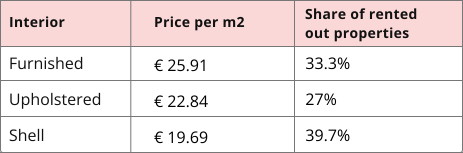
Pararius distinguishes between three types of rental delivery: unfurnished1, semi-furnished2, and fully furnished3. In the third quarter of 2025, 39.7 percent of removed listings consisted of unfurnished homes. New tenants in the Netherlands paid an average of €19.69 per square metre per month for these properties. Semi-furnished rental homes accounted for 27 percent of the supply, with an average rent of €22.84 per square metre, while fully furnished homes represented 33.3 percent of removed listings and were the most expensive, averaging €25.91 per square metre. As a result, a growing share of the Dutch unregulated housing sector is being rented out unfurnished, while the proportion of fully furnished homes continues to decline.
Rental price developments in Dutch cities
Pararius also reports on rent developments at the local level. These figures are based on locations where at least thirty unregulated housing sector rental homes were removed from listings during the quarter. In the third quarter of 2025, the majority of measured cities saw an increase in the average rent per metre compared to a year earlier.
Within the G5 (Amsterdam, The Hague, Eindhoven, Rotterdam, and Utrecht), all five cities recorded a percentage increase in rent. In Amsterdam, new tenants paid an average of €27.75 per metre, nearly 4 percent more than a year earlier. Rotterdam (+7.6%, €22.05), The Hague (+7.4%, €21.90), and Utrecht (+11.3%, €22.34) followed a similar pattern. The most notable increase occurred in Eindhoven, where rent rose by 15.2 percent to €19.86 per metre.
According to Hugo Veldhuis, owner of 123Wonen Eindhoven, this is related to the strong influence of various high-tech companies that have driven the regional economy for years. “Until two years ago, the rapid growth of these high-tech companies ensured a constant inflow of international employees,” Veldhuis explains. “That growth has now leveled off, but many landlords still base their expectations on the peak years, when expats settled in Eindhoven en masse.”
Fiscal and financial factors also play a role. Veldhuis adds: “Landlords face higher costs and tax burdens, including box 3, the adjusted point system, and stricter rules for type A rental contracts, which require a minimum term of twelve months and then automatically continue indefinitely. To maintain returns, they ask for higher rents or decide to sell properties. This creates a rather toxic cocktail: less supply, higher expectations, and rents rising faster than tenants can afford or are willing to pay.”
The strongest percentage increases were measured in smaller and medium-sized cities, such as Deventer (+21.6%), Schiedam (+20.7%), Helmond (+19.1%), Rijswijk (+18.1%), and Hoorn (+16.6%). These outliers can partly be explained by the relatively small number of homes in these markets: a limited number of higher-priced transactions can quickly raise the average.
On the other hand, some cities saw rent decreases, including Veldhoven (–5.6%), Gouda (–4.5%), Zwolle (–3.7%), Nieuwegein (–3.3%), and Amersfoort (–1.3%).
Amsterdam remains the most expensive city in the Netherlands, followed by Amstelveen (€25.16), Haarlem (€23.17), Utrecht (€22.34), and Rotterdam (€22.05). The lowest rent per metre was measured in Apeldoorn (€14.13), Bergen op Zoom (€14.49), Zwolle (€14.86), Leeuwarden (€14.90), and Enschede (€15.28).
Provinces
In the third quarter of 2025, the average rent per metre increased in almost all provinces compared to a year earlier. The largest price increase was measured in Drenthe, where new tenants paid 16.3 percent more than a year ago. The average rent per metre there was €14.88. In Overijssel (+13.3%, €15.27), North Brabant (+11.5%, €18.05), Friesland (+10.5%, €14.39), and Flevoland (+10.1%, €18.63), increases were also well above the national average.
The spikes in Drenthe and Overijssel are mainly due to the relatively small number of rental homes available in these provinces. A few homes in a higher-priced segment can therefore significantly raise the average, causing price developments in these provinces to fluctuate more strongly than in others.
In the Randstad provinces, rents also continued to rise. North Holland remains the most expensive province in the Netherlands: new tenants paid 3.8 percent more than a year earlier in the third quarter of 2025, with an average of €24.59 per metre. In South Holland, prices increased by 6.7 percent to €20.61, and in Utrecht by 9.2 percent to €20.20.
The only province where little change was observed this quarter is Groningen, where the average rent per metre remained virtually unchanged (+0.7%) at €17.71. In the other provinces, including Zeeland (+9.7%, €15.04) and Limburg (+9.4%, €15.93), rents clearly continued to rise.
About Pararius
Pararius is the largest independent housing platform in the Netherlands. Only professional real estate agents - including NVM, Vastgoed Nederland - as well as housing associations, property managers, investors and developers are allowed to list properties on the platform. More than 4.500 rental and sales professionals use Pararius, ensuring the listings are both up-to-date and representative of the Dutch unregulated rental housing stock.
The platform receives over 2.5 million visitors per month. These visitors have year-round access to more than 60,000 properties. Pararius is available in six languages and is the leading rental platform for expats in the Netherlands, serving over 350.000 international knowledge workers living and working in the country.
Click here for a detailed explanation of the calculations.