
Unregulated rental market in the Netherlands under increasing pressure
Prospective tenants must earn €800 more than a year ago, supply down by 36 percent
Pararius Rental Report Q2 2025
The number of available rental properties in the unregulated sector in the Netherlands dropped by 36.4% in the second quarter of 2025 compared to the same period last year, according to data analysis by rental platform Pararius. The average rental price per square metre rose by 7.9%. Meanwhile, demand for unregulated rental properties in the Netherlands continued to grow. Listings received an average of 57 responses, the highest level since Pararius began measuring. At the same time, the average monthly rent increased to €1.830, requiring a gross monthly income of over €5.490. The most pressure remains in the segment up to €1.500 per month, but higher price ranges are also seeing a growing number of responses.
Number of available rental properties in the unregulated sector
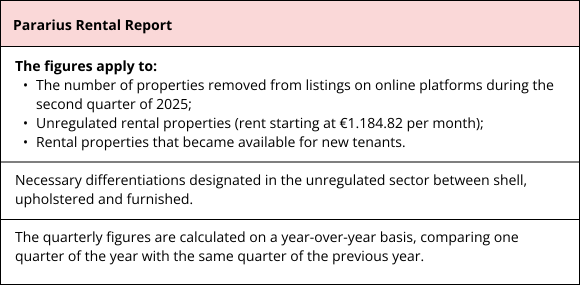
This analysis is based on rental listings from Pararius, Huurwoningen.nl and other public data sources.1 In the second quarter of 2025, a total of 12.744 unregulated rental properties became available across the Netherlands. That is 36.4 percent fewer than in the same quarter of 2024, when 20.026 properties were listed. In total, 13.655 unregulated rental properties were delisted this quarter: a 30.2 percent decrease compared to the second quarter of 2024 (19.561). The continued decline in available rental supply increases competition among prospective tenants and puts additional upward pressure on rental prices.
In the second quarter of 2025, an unregulated rental property remained online for an average of 18 days. That is one day shorter than a year earlier and the lowest level since Pararius began tracking this metric. The listing duration remains exceptionally short, underscoring the ongoing tightness in the Dutch rental market.
Average number of responses per listing
In the second quarter of 2025, an unregulated rental property received an average of 57 responses. This marks a significant increase from 41 responses a year earlier and is the highest level recorded since measurements began in 2021. The number of responses peaked this quarter, indicating that competition in the rental market continues to grow structurally.
Competition among prospective tenants in the Netherlands remains most intense in the lower segment of the unregulated sector, with monthly rents between €1.185 and €1.500. Over 35 percent of all responses were directed at properties in this category, while it accounted for only 27 percent of the available listings. For many tenants, this is the only part of the market that is still relatively within financial reach. As a result, properties in this segment are rented out very quickly.
The “middle ground” of the unregulated sector (€1.500 to €2.000 per month) is now also starting to show signs of pressure. In the second quarter of 2025, this price category received 40.9 percent of all responses, compared to a 33.8 percent share of the available supply. This segment is increasingly becoming the new focal point of the rental market. With fewer properties available below €1.500, many tenants appear to be shifting their search to more expensive homes out of necessity.
In the highest segment (rents above €2.000 per month), supply continues to outpace demand. This category accounted for 39.2 percent of listings but attracted only 23.7 percent of responses. Nevertheless, interest in high-end rental properties is growing: in the first quarter of 2025, this segment still received just 18.3 percent of responses.
Pressure on the Dutch rental market
To provide insight into market conditions, Pararius developed a metric that reflects the balance between supply and demand on the Dutch rental market, based on four key elements: total supply, the number of newly listed properties, the average time a property remains online, and the average number of responses per listing.
In the second quarter of 2025, the indicator dropped to 0.32, the lowest level since the measure was introduced. This clearly reflects a so-called landlord’s market, where demand significantly outweighs supply. The indicator also remained low in the fourth quarter of 2024 (0.47) and the first quarter of 2025 (0.46), marking three consecutive quarters of extreme tightness. Properties are rented out faster, attract more responses, and remain online for shorter periods. This ongoing pressure translates into intensified competition and upward pressure on rental prices in the unregulated sector.
Average rent vs. required gross income
In the second quarter of 2025, new tenants in the Netherlands paid an average of €1.830 per month for a rental property in the unregulated sector. Based on the common rule that tenants must earn at least three times the monthly rent, this requires a gross monthly income of over €5.490. That is more than €800 higher than a year ago, when the required income stood at €4.675, based on an average rent of €1.558. Over the past twelve months, the average rent has increased by 17.4 percent.
The average price per square metre also continued to rise. In the second quarter of 2025, new tenants in the Netherlands paid €20.06 per square metre per month, an increase of 7.9 percent compared to the same quarter last year. For the first time since Pararius began tracking this data, the national average price per square metre in the unregulated sector has exceeded twenty euros.
Jasper de Groot, CEO of Pararius: “The gap between what a rental property costs in the Netherlands and what people can afford is growing every quarter. As rental prices rise, so does the minimum income required to qualify. We see a growing group of people who earn too much for regulated housing but not enough to access the unregulated sector. These middle-income earners are stuck. Unless supply increases in the Netherlands, nothing will change. The unregulated sector used to be a safety net for people in urgent need of flexible housing, but that safety net is starting to fail. Think of people going through a divorce or recent graduates starting a job in a new city. Their housing security is now under pressure.”
Pararius Rental Price Index (PHI)
Since the third quarter of 2024, Pararius has included a rental price index in its reports. The Pararius Rental Price Index (PHI) tracks the development of average rental prices in the unregulated sector and compares them with both the Dutch Consumer Price Index (CPI) and the House Price Index (HPI). For all three series, the base quarter is set at Q1 2021 = 100. This approach aims to provide a transparent and comprehensive overview of developments in the Dutch rental market.
Rental prices in the unregulated sector are now rising faster than inflation in the Netherlands. This was already the case in the previous quarter and continued in the second quarter of 2025. For a long time, the rental market lagged behind the owner-occupied market in terms of price development, where prices have exceeded inflation in nearly every quarter since early 2021. The two markets now appear to be moving in a similar direction, suggesting that rental price growth in the unregulated sector is increasingly aligning with the housing market as a whole.
Shift from rental to owner-occupied market
In the second quarter of 2025, 2.112 rental properties in the Netherlands were transferred to the owner-occupied market via the Pararius platform. This marks the highest number of properties withdrawn from the rental sector since the start of measurements and represents an increase of 42.1 percent compared to the 1.486 properties in the same quarter of 2024. The share of total owner-occupied listings originating from the Dutch rental market stood at 7.2 percent in Q2 2025, up from 6 percent a year earlier. Although this share appears to be declining compared to the previous quarter, the absolute number of former rental properties entering the owner-occupied market continues to rise.
This apparent decline masks a structural outflow from the unregulated sector: more and more rental properties are being sold rather than re-let. At the same time, the number of regular owner-occupied listings (homes sold by owner-occupiers) is also increasing, which expands the total owner-occupied supply and reduces the relative share of former rental homes—despite their growing volume.
Average rental price per property type
In het tweede kwartaal van 2025 is de gemiddelde huurprijs per vierkante meter opnieuw gestegen voor zowel appartementen als eengezinswoningen. Nieuwe huurders betaalden gemiddeld €21,31 per vierkante meter voor een appartement, een stijging van 9,5 procent ten opzichte van een jaar eerder. Voor een eengezinswoning kwam de gemiddelde huurprijs uit op €16,11 per vierkante meter, 9,2 procent hoger dan in het tweede kwartaal van 2024.
Delivery types in the Netherlands
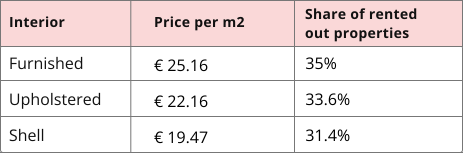
Pararius distinguishes between three delivery types: shell1, upholstered2 and furnished3. In the second quarter of 2025, bare rental properties accounted for 31.4 percent of all delisted listings. New tenants in the Netherlands paid an average of €19.47 per square metre per month for these homes. Upholstered properties made up 33.6 percent of the market, with an average price of €22.16 per square metre. Furnished homes represented 35 percent of all delisted listings and were the most expensive, with an average price of €25.16 per square metre.
Rental price developments in Dutch cities
Pararius also reports on local rental price trends. These figures are based on cities where at least thirty unregulated sector rental properties were delisted during the quarter. In the second quarter of 2025, the majority of measured municipalities saw an increase in the average rental price per square metre compared to the same period last year.
This was also the case in the G5 (Amsterdam, The Hague, Eindhoven, Rotterdam and Utrecht), where rental prices rose in all five cities. In Amsterdam, new tenants paid an average of €27.91 per square metre, an increase of 2.2 percent year-on-year. Rental prices also rose in Rotterdam (+7.2 percent, €21.52), The Hague (+6.8 percent, €21.34), Utrecht (+1.2 percent, €21.60), and Eindhoven (+4.3 percent, €18.38), continuing the upward trend in all major cities.
The strongest price increases this quarter were again observed in smaller and mid-sized cities outside the Randstad region. In Roermond, the average price per square metre rose by 28.3 percent to €16.80. Significant increases were also recorded in Hoorn (+25.4 percent, €20.79), Leeuwarden (+24.8 percent, €15.28), Bussum (+23.2 percent, €22.65), and Arnhem (+13.9 percent, €16.67).
In several cities, however, the average rental price per square metre decreased in the second quarter of 2025. The sharpest decline was recorded in Hoofddorp, where prices fell by 7.4 percent to €20.19. Rental prices also declined in Zwolle (–7.1 percent, €13.80), Heemstede (–6.2 percent, €19.93), Zeist (–5.2 percent, €17.83) and Ede (–2.4 percent, €14.46). In many of these cases, the decline is partly explained by a shift in the types of properties rented; for instance, a higher proportion of larger homes, which generally have a lower price per square metre.
Amsterdam remains the most expensive city in the Netherlands, followed by Amstelveen (€23.38), Bussum (€22.65), and Haarlem (€21.66). The lowest average rental prices per square metre were recorded in Zwolle (€13.80), Bergen op Zoom (€14.13), and Helmond (€14.19).
Provinces
In the second quarter of 2025, the average price per square metre increased in every Dutch province compared to a year earlier. The largest year-on-year increase was recorded in Drenthe, where new tenants paid 16.7 percent more than the year before. The average rental price per square metre there reached €14.94. Significant increases were also observed in Limburg (+16.3 percent, €16.22), Friesland (+12.3 percent, €13.69), and Gelderland (+10.6 percent, €15.71). Although price levels in these provinces remain below the national average, the rental market is clearly becoming more expensive across the board.
Rental prices also rose in the three so-called Randstad provinces. In Noord-Holland - still the most expensive province in the Netherlands - the average rental price per square metre increased by 4.2 percent to €24.52. In Zuid-Holland and Utrecht prices rose by 5.6 percent (€20.15) and 6.2 percent (€19.88), respectively.
Rental growth continued in the remaining provinces as well. Prices increased year-on-year in Overijssel (+6.2 percent, €14.43), Noord-Brabant (+6.4 percent, €17.05), Groningen (+5.7 percent, €17.66), Zeeland (+8.9 percent, €14.85), and Flevoland (+9.4 percent, €17.39).
About Pararius
Pararius is the largest independent housing platform in the Netherlands. Only professional real estate agents - including NVM, Vastgoed Nederland - as well as housing associations, property managers, investors and developers are allowed to list properties on the platform. More than 4.500 rental and sales professionals use Pararius, ensuring the listings are both up-to-date and representative of the Dutch unregulated rental housing stock.
The platform receives over 2.5 million visitors per month. These visitors have year-round access to more than 60,000 properties. Pararius is available in six languages and is the leading rental platform for expats in the Netherlands, serving over 350.000 international knowledge workers living and working in the country.
Click here for a detailed explanation of the calculations.