
Affordable rental homes are disappearing from the market in the Netherlands
Rents continue to rise as rental homes move into owner occupation
Pararius Rental Report Q4 2025
Reading time: 8 minutes
Rotterdam, Wednesday 14 January 2026 – The unregulated housing sector remained structurally tight in the fourth quarter of 2025, according to an analysis by property portals Pararius and Huurwoningen.nl. Although the average number of responses per rental home was lower than in earlier quarters, competition among tenants remains intense. A home in the unregulated housing sector attracted an average of 31 responses and was listed online for an average of 18 days. The average monthly rent stood at €1,838.
The figures point to a widening gap in the market. Most people searching for a home focus on the more affordable end of the rental market, while supply in that segment is disappearing and increasingly shifting towards the higher price ranges of the unregulated housing sector. As a result, securing a suitable rental home is becoming ever more difficult for a growing number of households.
Number of available rental properties in the unregulated sector
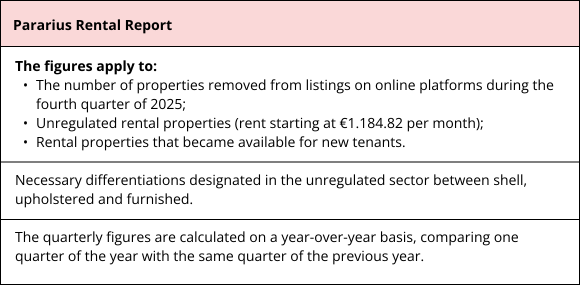
In the fourth quarter of 2025, 14,698 homes in the unregulated housing sector were newly listed across the Netherlands, while 15,188 properties were withdrawn from the market over the same period. As a result, more rental homes once again disappeared than were added, further reducing the available supply in the Dutch unregulated housing sector.
Jasper de Groot, CEO of Pararius, commented: “As long as more homes are being let than are coming onto the market, this is bad news for people looking for a place to live in the Netherlands. Properties that do become available are often unaffordable and are snapped up quickly. In effect, the market is becoming increasingly locked up.”
Supply by Price Segment
In recent years, the supply of rental homes in the unregulated housing sector has not only declined in size but has also changed markedly in composition. Since 2021, the number of rental properties with a monthly rent below €1,500 has fallen sharply and now sits structurally below the levels seen before 2024. As a result, the most affordable part of the rental market is under significant pressure.
At the same time, supply has increased in the higher price categories. The number of rental homes with monthly rents above €2,000 has grown steadily, while the segment between €1,500 and €2,000 per month has remained relatively stable. This has led to the different price segments becoming much closer in size.
Overall, the composition of the rental supply has changed fundamentally compared with a few years ago. Where the market was previously clearly dominated by homes in the more affordable segment, supply in that segment has now shrunk considerably, while higher-priced categories have become far more prominent in relative terms.
Rental homes in the Dutch unregulated housing sector are therefore continuing to disappear from the market at pace. In the fourth quarter of 2025, a property was advertised online for an average of just 18 days, one day fewer than in the same quarter a year earlier. Marketing times have fallen sharply over recent years and have remained low since the fourth quarter of 2021. While there have been occasional minor fluctuations, rental properties generally remain available for only a short period, a pattern that persisted throughout 2025.
These fluctuations reflect the turbulence surrounding the introduction of the new Affordable Rent Act (Wet Betaalbare Huur), which came into force in July 2024. During this period, the composition of the rental stock shifted as smaller, more affordable homes, which are typically let more quickly, were sold off. Larger and more expensive properties, by contrast, remained on the market and tended to be advertised for longer.
Average number of responses per listing
In the fourth quarter of 2025, a home in the unregulated rental sector attracted an average of 31 responses, representing a 24 percent decline compared with the same quarter a year earlier.
An analysis of supply and demand across different price categories within the unregulated rental sector clearly shows where pressure in the market is most acute. Homes with monthly rents between €1,185 and €1,500 accounted for just over a quarter of the available supply in the fourth quarter of 2025, yet attracted more than 40 percent of all responses. In this price bracket, demand far outstrips supply.
Interest was also relatively strong in the €1,500 to €2,000 per month range. These homes made up around 34 percent of the available supply, while approximately 39 percent of responses were directed towards them. Although the imbalance between supply and demand is less pronounced than in the lower price segment, competition remains intense.
At the upper end of the market, with monthly rents above €2,000, roughly 40 percent of the available supply in the fourth quarter of 2025 fell into this category, while only 21 percent of responses were recorded. A year earlier, higher-priced homes accounted for a smaller share of supply, at around 33 percent, while approximately 16 percent of responses related to this segment. This indicates that supply in the highest price range has grown more rapidly than demand, further widening the gap between the two.
Overall, this comparison shows that pressure in the unregulated rental sector is driven not only by the number of people searching for a home, but primarily by the uneven distribution of supply and demand across different price categories.
Pressure on the Dutch rental market
The Pararius tightness indicator offers a snapshot of the balance between supply and demand in the unregulated rental sector in the Netherlands. It is based on a combination of factors, including the size of the available housing stock, the number of new listings, how long properties remain advertised and the volume of responses per home.
In the fourth quarter of 2025, the indicator stood at 0.62, underscoring that the unregulated rental market remains firmly a landlord’s market. Although the figure is slightly higher than in previous quarters, there is no evidence of a structural shift. Limited supply, consistently short advertising periods and a persistently high level of interest per property continue to define the market. As a result, the Dutch unregulated rental sector remains far from balanced.
Average rent vs. required gross income
The average monthly rent for a home in the unregulated rental sector reached €1,838 in the fourth quarter of 2025, an increase of 6.5 percent compared with a year earlier. Landlords in this segment typically apply the rule that tenants must earn at least three times the monthly rent. For an average property, this translates into a required gross monthly income of around €5,515.
At this income level, a large share of the unregulated rental sector is out of reach for many people searching for a home. Tenants on an average income often fail to meet the requirement on their own. Meanwhile, the supply of available rental homes remains limited and is increasingly concentrated in higher price brackets. A growing number of properties now command rents above €2,000 per month, while most prospective tenants are searching in the lower end of the market. As a result, demand is concentrated on a relatively small part of the available supply, intensifying competition in the lower price categories.
Pararius Rental Price Index (PHI)
Since the start of 2025, rents in the unregulated housing sector have been rising faster than inflation, measured against the 2021 base year, a trend that continued into the fourth quarter of 2025. Compared with that base year, rents have now increased by 31.8 percent. Over the same period, inflation rose by 25.8 percent, while house prices climbed by 42.9 percent.
As a result, rents in the unregulated housing sector have moved clearly ahead of broader price developments in the economy. After lagging behind inflation for many years, renting has in recent times become relatively more expensive than many other recurring household costs, including everyday expenses.
This trend also persisted over the past year. Compared with the fourth quarter of 2024, rents per square metre rose by approximately 8.3 percent, while inflation over the same period increased by around 3.4 percent.
Shift from rental to owner-occupied market
In the fourth quarter of 2025, the outflow of rental homes to the owner-occupied market remained evident, although it was less pronounced than in previous quarters. This process continues to affect the unregulated housing sector. During the past quarter, 6.5 percent of all homes listed for sale on Pararius had previously been offered as rental properties in the unregulated housing sector. While this share is lower than in 2024 and early 2025, when it exceeded 7 percent, it remains clearly higher than in earlier years.
Movement in the opposite direction remains limited. Of all rental homes listed in the fourth quarter, just 1.6 percent had previously been part of the owner-occupied market.
The trend of investors and private landlords selling off vacated rental properties has been widely recognised since 2023. This continued loss of rental homes is a key factor behind the shrinking supply of rental housing and the intensifying competition faced by people searching for a home.
Average rental price per property type
Across the Netherlands, new tenants paid more per square metre for homes in the unregulated housing sector in the fourth quarter of 2025 than a year earlier. The increase was particularly pronounced for apartments. The average rent for an apartment rose to €22.06 per square metre, an increase of 10 percent year on year. Single-family homes also became more expensive, with new tenants paying an average of €16.16 per square metre, up 4.8 percent compared with the fourth quarter of 2024.
Nationwide, the average rent reached €20.65 per square metre, representing an annual increase of 8.3 percent. These figures underline that price pressure in the unregulated housing sector remains persistently high.
Delivery types in the Netherlands
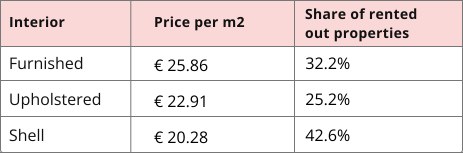
Pararius distinguishes between three types of rental delivery: unfurnished1, semi-furnished2, and fully furnished3. In the fourth quarter of 2025, most homes in the unregulated housing sector were let as shell properties, accounting for approximately 42.6 percent of all lettings. New tenants paid an average of €20.28 per square metre for these homes, making shell rentals the most affordable option within the unregulated housing sector.
Upholstered rental homes accounted for 25.2 percent of withdrawn listings, with an average rent of €22.91 per square metre. Furnished properties made up 32.2 percent of the supply and were the most expensive category, commanding an average rent of €25.86 per square metre.
Rental price developments in Dutch cities
An analysis of rent developments at city level shows that average rents per square metre increased in most Dutch cities in the fourth quarter of 2025. The figures are based on cities where at least thirty homes in the unregulated housing sector were withdrawn during the quarter.
Within the G5 cities of Amsterdam, The Hague, Eindhoven, Rotterdam and Utrecht, all five recorded higher rents per square metre. Amsterdam remains by far the most expensive city in the Netherlands, with an average rent of €28.68 per square metre, up 9.1 percent compared with a year earlier. Rents also rose sharply in Rotterdam (€22.35, +11.2 percent) and Eindhoven (€19.72, +13.8 percent). The Hague (€21.52, +5 percent) and Utrecht (€21.95, +4.8 percent) saw more moderate increases.
The strongest percentage increases were recorded in medium-sized cities. In Rijswijk, rents per square metre rose by 23.4 percent, followed by Hoorn (+20.4 percent) and Tilburg (+20.1 percent). Increases of more than 10 percent were also observed in Leiden (+17.3 percent), Roermond (+17.3 percent), Enschede (+13.8 percent) and Maastricht (+12.9 percent) compared with a year earlier. In several of these cities, the rise is partly explained by changes in the type of homes let. In Rijswijk, Hoorn and Tilburg, for example, smaller properties were withdrawn on average in the fourth quarter of 2025 than a year earlier. As smaller homes tend to command higher rents per square metre, this pushed up the average price more quickly.
Only two cities recorded a slight decline in rents during the quarter. In Nijmegen, the average rent fell to €16.50 per square metre, a decrease of 0.8 percent year on year. In Purmerend, rents also edged down by 0.8 percent to €19.37 per square metre.
Looking at absolute price levels, differences between cities remain substantial. After Amsterdam, the most expensive rental markets include Amstelveen (€23.91), Leiden (€23.77), Haarlem (€22.52), Rotterdam (€22.35) and Utrecht (€21.95). At the lower end of the market are cities such as Apeldoorn (€13.97), Enschede (€15.44), Zoetermeer (€15.65) and Zwolle (€16.33), where average rents per square metre are significantly lower.
Provinces
In the fourth quarter of 2025, average rents per square metre rose in all Dutch provinces compared with a year earlier. The strongest increase was recorded in Zeeland, where the average rent climbed by 14.4 percent to €15.41 per square metre. Substantial increases were also seen in Limburg (+12.3 percent, €16.06), Friesland (+12.0 percent, €14.24), Noord-Brabant (+11.9 percent, €18.12) and Overijssel (+10.5 percent, €15.30) compared with the fourth quarter of 2024.
Price pressure also remained evident in the Randstad. Noord-Holland continues to be the most expensive province in the Netherlands, with an average rent of €25.26 per square metre, up 10.3 percent year on year. In Zuid-Holland, rents rose by 9.2 percent to €20.86 per square metre, while Utrecht recorded an increase of 6.4 percent, bringing the provincial average to €20.00 per square metre.
By contrast, rent growth was far more modest in Flevoland and Gelderland. In Flevoland, the average price per square metre edged up by just 0.6 percent to €18.00, while Gelderland saw a 1.9 percent increase to €15.55. In the fourth quarter of 2025, price developments in these provinces were noticeably more subdued than elsewhere in the country.
About Pararius
Pararius has been collecting and analysing data on the Dutch unregulated housing sector for many years. The figures in this rental monitor are based on rental homes that are listed and withdrawn via Pararius by professional market participants. These are properties that were genuinely available for rent and for which information on rent levels, property characteristics and listing duration is known.
Because Pararius continuously tracks new listings, completed lettings and price developments, its data provides a timely and representative picture of the unregulated housing sector. This rental monitor is compiled using anonymised listing data and is updated on a quarterly basis. A detailed explanation of definitions and calculation methods is included in the methodology section.
Written by: Jasper de Groot, Femke Radder and Jeroen Wernekinck
Download the full report Q4 2025
Leave your details and download the full rental report in PDF.
Request now